Precious metals IRA fees fall into four buckets: setup ($50-$250), custodian ($80-$250/year), storage ($150 minimum for segregated storage), and buyback spreads of 3-7%. Birch Gold Group brings 20+ years of experience since 2003 with BBB A+ rating with transparent disclosure.
2026 contribution limits, IRS-approved metals, fee breakdowns, and top gold IRA companies compared.





Augusta Precious Metals — America's #1 rated Gold IRA company. No obligation, ships in 24-48h.
Get Free Kit →✓ No obligation ✓ 100% Free ✓ A+ BBB Rated
A gold IRA is a self-directed IRA that lets you hold IRS-approved physical gold — and other precious metals — as part of your tax-advantaged retirement savings. Unlike a traditional IRA at Fidelity, Vanguard, or Schwab that typically holds stocks, bonds, and mutual funds, a self-directed IRA (SDIRA) allows direct ownership of physical bullion bars and coins that meet IRS fineness standards.
With a gold IRA, you can invest in gold bullion bars (minimum 0.995 fineness), American Eagle coins, Canadian Maple Leaf coins, and other approved precious metals including silver, platinum, and palladium. Investors use precious metals IRAs primarily for three reasons: (1) portfolio diversification beyond correlated stock/bond assets, (2) an inflation hedge — gold gained 25% in 2022 when CPI hit 9.1% while the S&P 500 fell 18%, and (3) reduced exposure to market volatility during recessions and geopolitical crises.
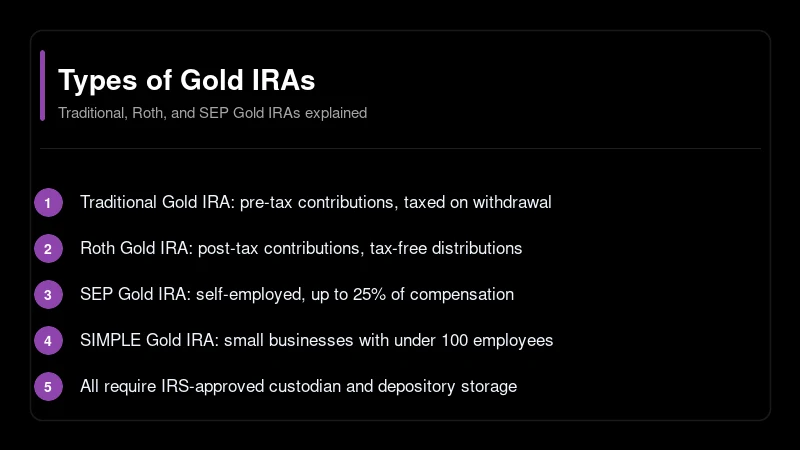
Gold IRAs come in three structures — Traditional, Roth, and SEP — each with distinct tax treatment, contribution limits, and withdrawal rules.
Traditional Gold IRAs use pretax dollars for contributions (if you qualify for the deduction), and assets grow tax-deferred. The IRS taxes traditional gold IRA withdrawals as ordinary income at your marginal rate in the year of distribution. Required minimum distributions (RMDs) begin at age 73 under current IRS rules. The 2026 contribution limit is $7,000 ($8,000 if age 50+). buy gold with ira money
Roth Gold IRAs use after-tax dollars. Qualified withdrawals are completely tax-free, making them attractive for investors who expect higher tax rates in retirement. Roth gold IRAs have no RMDs during the owner's lifetime, allowing metals to appreciate indefinitely.
SEP Gold IRAs serve self-employed individuals and small business owners, allowing employer contributions up to $69,000 in 2026 — nearly 10x the standard IRA limit. SEP gold IRAs allow up to $69,000 in 2026 employer contributions — 9.9× the $7,000 traditional IRA limit — enabling self-employed investors to allocate six-figure sums to precious metals in a single tax year.
Yes — you can hold physical gold in a traditional IRA, but only through a self-directed IRA (SDIRA) with an IRS-approved custodian. Standard traditional IRAs at Fidelity, Vanguard, or Schwab do not permit physical precious metals; they allow only gold ETFs (like GLD or IAU) or gold mining stocks.
To buy actual gold coins or bullion in a traditional IRA: (1) open a self-directed IRA with a specialized custodian such as Equity Trust or GoldStar Trust, (2) fund it via a direct rollover from a 401(k)/403(b) or annual contribution, and (3) purchase only IRS-approved metals — gold must meet a 0.995 fineness minimum for bars or qualify as government-issued legal tender (e.g., American Eagle coins, which are exempt from the fineness rule under IRC Section 408(m)(3)(A)). The IRS prohibits home storage of gold IRA metals and requires your custodian to ship all physical bullion directly to an IRS-approved depository such as Brink's or the Delaware Depository (IRS Publication 590-A).
Fidelity does not offer physical gold IRA accounts. Through Fidelity, you can buy gold ETFs (GLD, IAU, SGOL), gold mining stocks, and gold mutual funds inside a standard IRA. For physical gold ownership, you need a separate self-directed IRA with a specialized custodian. Some investors maintain both: a Fidelity IRA for stocks/bonds and a self-directed gold IRA for physical metals.
The IRS permits four metals — gold, silver, platinum, and palladium — each subject to strict fineness minimums before qualifying for IRA inclusion.
| Metal | Minimum Fineness | Popular IRA-Eligible Products |
|---|---|---|
| Gold | 0.995 (99.5%) | American Eagle, Canadian Maple Leaf, Austrian Philharmonic, PAMP Suisse bars |
| Silver | 0.999 (99.9%) | American Silver Eagle, Canadian Silver Maple Leaf, 10 oz silver bars |
| Platinum | 0.9995 (99.95%) | American Platinum Eagle, Canadian Platinum Maple Leaf |
| Palladium | 0.9995 (99.95%) | Canadian Palladium Maple Leaf |
The IRS excludes numismatic coins, collectibles, and jewelry from gold IRAs regardless of metal content (IRC §408(m)(2)); only government-issued bullion coins and LBMA-approved refiner bars meeting minimum fineness standards qualify. American Eagle coins are a notable exception to the fineness rule — they are 0.9167 fine (22-karat) but explicitly approved by Congress under IRC Section 408(m)(3)(A).
For 2026, you can contribute up to $7,000 to a gold IRA annually — or $8,000 if you are age 50 or older (the $1,000 catch-up provision). The IRS applies a single combined $7,000 contribution cap across every IRA you own — not per account — as defined in IRS Publication 590-A.
| Account Type | 2026 Limit (Under 50) | 2026 Limit (50+) | Notes |
|---|---|---|---|
| Traditional/Roth Gold IRA | $7,000 | $8,000 | Combined limit across all IRAs |
| SEP Gold IRA | 25% of comp or $69,000 | 25% of comp or $69,000 | Employer contributions only |
| Rollover (401k/IRA) | No limit | No limit | Tax-free if direct transfer |
The most tax-efficient way to fund a gold IRA above the $7,000 annual cap is a direct rollover (trustee-to-trustee transfer) from a 401(k), 403(b), or existing IRA — rollovers have no dollar cap and generate no 1099-R withholding. With an indirect rollover, you receive the funds personally and must redeposit 100% within 60 days or the shortfall is treated as a taxable distribution plus a 10% early withdrawal penalty if under age 59½.
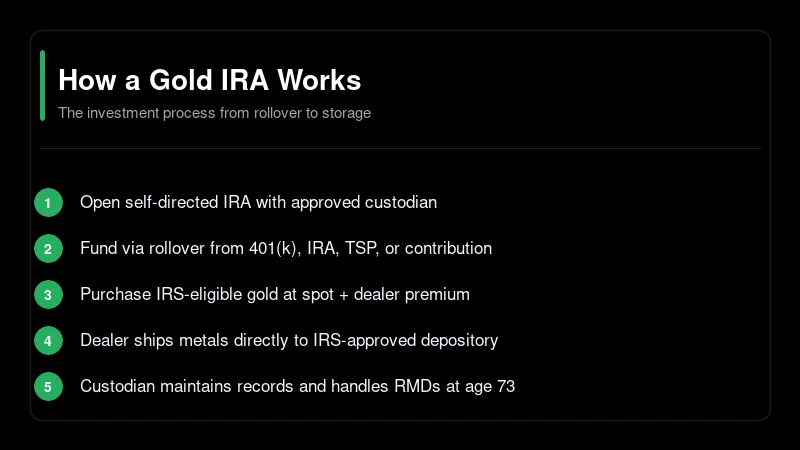
Opening a gold IRA takes four steps: choose a custodian, fund the account, select IRS-eligible metals, and arrange storage at an approved depository.
Step 1: Select a Specialized Custodian. Your custodian acts as the IRA trustee, handles IRS paperwork (Form 5498 and 1099-R), and coordinates with the depository.
Step 2: Fund the Account. Open your self-directed IRA and fund it via direct rollover from a 401(k)/403(b)/existing IRA (no dollar limit, no tax impact) or annual contribution (up to $7,000/$8,000 in 2026).
Step 3: Purchase IRS-Approved Metals. Select gold bars (0.995+ fineness), American Eagle coins, Canadian Maple Leafs, or other eligible products. Verify pricing against the current gold spot price — dealer premiums typically run 3-8% above spot.
Step 4: Arrange Depository Storage. IRS regulations mandate that your gold IRA custodian transfer all physical metals directly to an approved depository — home storage triggers immediate distribution treatment and tax penalties. Choose between segregated storage (your metals stored separately) or commingled storage (pooled with other investors, typically lower cost).
A gold IRA typically costs $200–$500 in year one and $150–$350 annually — fees include setup, maintenance, storage, and a 3–8% dealer premium above the gold spot price.
Expect four cost layers:
(1) Account setup fee: $50–$150 one-time, charged by the custodian to open your self-directed IRA.
(2) Annual maintenance fee: $75–$300/year for account administration, IRS reporting (Forms 5498, 1099-R), and recordkeeping.
(3) Storage fee: 0.5%–1% of assets annually, or a flat $100–$175/year, paid to the IRS-approved depository (e.g., Brink's, Delaware Depository). Allocated (segregated) storage — your specific bars stored separately with individual serial numbers — costs more than unallocated (commingled) storage but guarantees you receive your exact bars/coins upon distribution. Verify that your depository provides an assay certificate for each bar confirming fineness and weight.
(4) Dealer premium: 3–8% above the gold spot price (the precious metals dealer markup), charged on every purchase. The bid-ask spread on physical gold is wider than on ETFs — factor this cost into your total return calculation. Look for dealers whose bars carry LBMA-approved refiner or COMEX-approved hallmarks for maximum liquidity at resale.
| Company | Setup | Annual | Storage | Min. Investment |
|---|---|---|---|---|
| Augusta Precious Metals | $50 | $80 | $100/yr | $50,000 |
| Goldco | $50 | $80 | $100/yr | $25,000 |
| Birch Gold Group | $50 | $75 | $100/yr | $10,000 |
| American Hartford Gold | $0* | $75 | $100/yr | $10,000 |
| Noble Gold | $80 | $80 | $150/yr | $20,000 |
A $50,000 initial investment may carry $1,500–$4,000 in first-year total costs (including dealer premium) — factor this into return projections.
Buy gold in an IRA if you want an inflation hedge, already max your tax-advantaged accounts, and have at least $10,000 to invest; skip it if your portfolio is under $10,000, you need income yield, or you cannot tolerate multi-year price drawdowns.
Reasons to buy gold in an IRA:
Reasons to skip a gold IRA:
Gold ETFs are cheaper (0.25% expense ratio, no storage fee) but represent paper claims on gold; gold IRAs hold allocated bullion with full IRS-recognized ownership but cost 5–10× more annually.
| Factor | Gold IRA (Physical) | Gold ETF (GLD/IAU) in Standard IRA |
|---|---|---|
| Annual Cost | $150–$350 + dealer premium | 0.25% expense ratio (e.g., IAU) |
| Ownership | Allocated physical bullion (your bars) | Paper claim on gold trust fund |
| Tax Treatment | Tax-deferred / tax-free (Roth) | Tax-deferred / tax-free (Roth) |
| Liquidity | 3–10 business days to liquidate | Instant (market hours) |
| Counterparty Risk | None (you own physical metal) | Trust fund and custodian risk |
| Min. Investment | $10,000–$50,000 | No minimum (share price ~$18–$200) |
For portfolios under $50,000, gold ETFs inside a Fidelity, Vanguard, or Schwab IRA typically deliver better net returns after fees. For portfolios above $100,000 where you want allocated physical metal with full ownership rights, a gold IRA makes economic sense.
Fidelity, Vanguard, and Schwab do not offer physical gold IRA accounts — they permit only gold ETFs (GLD, IAU, SGOL) and gold mining stocks inside standard IRAs.
These custodians are not licensed as self-directed IRA trustees under IRC §408(a). Physical gold IRA accounts require a specialized SDIRA custodian (Equity Trust, GoldStar Trust, Strata Trust) to handle IRS-required depository arrangements, assay certificates, and the Form 5498 reporting for alternative assets.
If you hold a gold ETF inside a Fidelity or Schwab Roth IRA, you benefit from low costs but do not own physical bullion. If physical ownership matters to you, open a separate self-directed IRA with a specialized custodian while keeping your Fidelity/Vanguard account for equities.
Gold returned approximately 5.5% annually over the past 20 years (LBMA PM fix data, 2005–2026) — below the S&P 500's ~10.5% annualized return but with near-zero equity correlation, making it a portfolio diversifier rather than a growth engine.
Historical Performance: A $10,000 investment in gold in 2005 would be worth approximately $73,000–$80,000 by early 2026, reflecting a 7–8x gain. A $1,000 investment in 2016 grew to roughly $2,600–$2,900 by 2026, a 160–190% return over 10 years. How much is 1 oz of gold right now? The gold spot price is approximately $3,050/oz as of April 2026 (LBMA PM fix), up from $1,800/oz in 2020 — a 69% gain. Retail 1-oz American Eagle coins trade $150–$250 above spot due to the 3–8% dealer premium and the bid-ask spread on physical bullion.
However, gold underperforms equities in bull markets — the S&P 500 returned approximately 10.5% annually over the same 20-year period versus gold's 5.5% annualized gain.
Gold IRAs carry four key risks: higher fees than standard IRAs, no dividend or interest income, price volatility, and liquidity constraints tied to depository release schedules.
Most financial advisors recommend allocating no more than 5–15% of a retirement portfolio to precious metals.
A gold IRA offers tax advantages and IRA legal protections; physical gold outside an IRA provides direct possession but no tax shelter and triggers capital gains tax at sale.
| Factor | Gold IRA | Physical Gold (Non-IRA) |
|---|---|---|
| Tax Treatment | Tax-deferred or tax-free (Roth) | 28% collectibles capital gains tax |
| Storage | IRS-approved depository required | Home safe, bank vault, or private vault |
| Access | Penalties before 59½; RMDs at 73 | Immediate, unrestricted |
| Annual Fees | $150–$350/year | $0–$150 (if using vault) |
| Creditor Protection | Federal bankruptcy protection | Varies by state |
| Insurance | Depository provides full coverage | Must arrange separately |
Gold ETFs (GLD, IAU) offer a third option: no storage hassle, instant liquidity, and low expense ratios (0.25–0.40%), but you do not own physical metal.
Withdrawals before age 59½ trigger a 10% early withdrawal penalty plus ordinary income tax; required minimum distributions (RMDs) begin at age 73 for traditional gold IRAs.
Traditional Gold IRA: Contributions may be tax-deductible. All withdrawals are taxed as ordinary income. RMDs must begin by April 1 of the year after you turn 73.
Roth Gold IRA: Contributions are after-tax. Qualified withdrawals after age 59½ (and 5+ years) are completely tax-free. No RMDs during the owner's lifetime.
Prohibited Transactions & Disqualified Persons: Self-dealing with IRA gold — storing metals at home, using IRA gold as personal collateral, or purchasing metals from a disqualified person (you, your spouse, lineal descendants, or their spouses) — triggers immediate distribution treatment under IRC §4975. The entire IRA balance may be deemed distributed, resulting in full ordinary income tax plus the 10% early withdrawal penalty. A checkbook IRA or LLC-owned IRA structure does not exempt you from these prohibited transaction rules.
UBIT (Unrelated Business Income Tax): Most gold IRA investments are passive and not subject to UBIT. However, if your self-directed IRA uses debt-financing (leverage) to purchase metals, the leveraged portion of gains may be subject to Unrelated Business Income Tax (UBIT/UBTI) under IRC §514.
In-Kind Distributions: At age 59½+ or when taking RMDs, you may take an in-kind distribution — receiving physical gold bars or coins rather than cash. The fair market value on the distribution date is treated as ordinary income for traditional gold IRAs, reported on Form 1099-R.
Opening a gold IRA takes less than two weeks: choose a company, open and fund the account, select metals, and confirm depository storage.
Understanding the true cost of a Gold IRA is essential before you commit. Unlike a standard brokerage IRA where you might pay $0 in annual fees, a self-directed Gold IRA carries several layers of expense that can meaningfully affect your net returns over time.
Most Gold IRA custodians charge a one-time account setup fee ranging from $50 to $150. Some waive this fee for larger initial deposits, typically $25,000 or more. Annual maintenance fees — covering account administration, IRS reporting, and record-keeping — typically run $75 to $300 per year, with flat-fee structures generally more favorable than percentage-based fees for larger accounts.
When you purchase IRS-approved bullion through your custodian's dealer network, you pay a markup above the spot price of the metal. Expect to pay a 3% to 8% premium on gold coins and bars. American Gold Eagle coins tend to carry higher premiums (4–8%) than gold bars (1–3%) due to their collectible recognition. This spread is real money out of pocket on every purchase.
The IRS requires all physical metals in a Gold IRA to be held in an approved depository — you cannot store them at home or in a private safe. Depository storage fees vary by structure:
Top approved depositories include Brink's, Delaware Depository, and IDS (International Depository Services). Annual fees may be charged as a flat rate or as a percentage of assets under custody (commonly 0.10%–0.35%).
Each time you buy or sell metals within the account, expect a per-transaction fee of $40–$75. When you take a distribution in the form of physical metal, the custodian may charge additional shipping and handling of $30–$100. Wire transfer fees of $25–$50 are also common when moving funds in or out of the account.
For a $50,000 Gold IRA account, realistic all-in annual costs might look like: $150 maintenance + $200 segregated storage + $100 in transaction fees = approximately $450/year, or 0.90% of assets. Compare this to a gold ETF expense ratio of 0.15%–0.40%, and you can see why fee comparison matters when choosing your investment vehicle.
A Gold IRA follows the same fundamental tax framework as a conventional IRA, but with some nuances specific to physical precious metals. Getting the tax rules right is critical — violations can trigger penalties, forced distributions, and immediate taxable events.
Contributions to a Traditional Gold IRA may be tax-deductible depending on your income and whether you or your spouse participate in a workplace retirement plan. In 2026, the deductibility phase-out for single filers covered by a workplace plan begins at $79,000 MAGI and phases out at $89,000. All growth within the account is tax-deferred. You pay ordinary income tax only when you take distributions in retirement.
Contributions to a Roth Gold IRA are made with after-tax dollars and are not deductible. However, qualified distributions in retirement — including all appreciation on the gold — are completely tax-free. In 2026, the Roth IRA contribution phase-out starts at $150,000 MAGI for single filers and $236,000 for married filing jointly.
Traditional Gold IRAs are subject to RMDs starting at age 73 under the SECURE 2.0 Act. Because your assets are physical metals, satisfying an RMD requires either selling enough metal to cover the required cash distribution or taking an in-kind distribution of the physical metal. Either approach is a taxable event. Roth Gold IRAs have no RMD requirements during the account holder's lifetime.
Distributions taken before age 59½ are subject to a 10% early withdrawal penalty on top of ordinary income tax, unless an exception applies (disability, first home purchase up to $10,000, substantially equal periodic payments, etc.). The same exceptions that apply to conventional IRAs apply to Gold IRAs.
The IRS classifies most gold coins and bullion that do not meet purity standards as collectibles. Purchasing a collectible inside an IRA is treated as a distribution equal to the purchase price in the year it occurs — meaning you owe income tax and potentially the 10% penalty. To avoid this, all metals must meet IRS purity requirements: 99.5% for gold, 99.9% for silver, 99.95% for platinum and palladium. The exception is American Gold Eagle coins, which are explicitly approved despite being only 91.67% pure gold.
Rolling funds from a 401(k) or traditional IRA into a Gold IRA via a direct trustee-to-trustee transfer is not a taxable event. A 60-day indirect rollover is also tax-free if completed within the 60-day window, but the distributing custodian will withhold 20% federal tax that must be replaced with out-of-pocket funds to avoid a partial taxable distribution.
When investors want gold exposure inside a retirement account, two primary vehicles exist: a physical Gold IRA and a gold-backed exchange-traded fund (ETF) held in a conventional brokerage IRA. Each has distinct cost structures, tax treatments, and practical trade-offs.
Gold ETFs carry very low expense ratios. SPDR Gold Shares (GLD) charges 0.40% annually while iShares Gold Trust (IAU) charges 0.25%. A physical Gold IRA typically costs 0.60%–1.50% annually when you add up custodian fees, storage fees, and dealer markups amortized over time. For a $100,000 position held for 10 years, this fee difference can compound into several thousand dollars.
This is where the comparison gets nuanced. Physical gold and gold ETFs that hold physical metal are both classified as collectibles by the IRS when held in a taxable account, subject to a maximum long-term capital gains rate of 28% rather than the standard 15%–20%. However, inside an IRA (either structure), the gains grow tax-deferred or tax-free regardless — the collectibles rate does not apply inside a tax-sheltered account. So the tax advantage of the IRA wrapper is the same for both options.
With a physical Gold IRA, you own specific bars or coins held in a regulated depository. With GLD or IAU, you own shares representing a fractional claim on gold held by a trust. During a severe financial crisis, ETF shares carry trust counterparty risk and could theoretically be suspended or halted. Physical metals in a depository are yours outright, with no third-party financial obligation standing between you and the asset.
Gold ETFs trade like stocks — buy or sell in seconds during market hours. Physical Gold IRA transactions require coordination between custodian and dealer, typically taking 3–10 business days to settle. For long-term retirement savers this rarely matters, but it is a real difference in emergency scenarios.
For most investors seeking convenience and low fees, a gold ETF like IAU inside a conventional IRA or Roth IRA is the more cost-effective choice. Physical Gold IRAs make the most sense for investors with $50,000 or more to allocate who prioritize direct ownership, want to hold metals outside the banking system, or plan eventually to take in-kind physical distributions in retirement.
Opening a Gold IRA is more involved than opening a standard brokerage IRA, but the process is straightforward when broken into clear steps. Most investors complete it within 1–3 weeks.
The IRS requires all self-directed IRAs to be administered by an approved custodian — a bank, trust company, or other IRS-approved institution. Prominent Gold IRA custodians include Equity Trust Company, STRATA Trust, and GoldStar Trust. Look for flat-fee structures, transparent storage arrangements, and an independent relationship with dealers (some custodians steer clients to high-markup affiliated dealers). Verify the custodian is registered with the IRS and in good standing.
You have three options to fund a new Gold IRA:
Transfers and rollovers are the most common funding methods since they allow much larger starting balances than the annual contribution limit permits.
Work with your custodian's approved dealer network to select metals that meet IRS purity requirements: gold at 99.5% purity minimum, silver at 99.9%, and platinum/palladium at 99.95%. IRS-approved gold products include American Gold Eagle coins (the only exception to the 99.5% rule), American Gold Buffalo coins, Canadian Gold Maple Leaf coins, Austrian Gold Philharmonic coins, and .9999 gold bars from approved refiners like PAMP Suisse and Credit Suisse.
Your custodian will direct the metals to an IRS-approved depository. You typically choose between segregated storage (your metals kept separately) and commingled storage (pooled with others, but tracked by weight and type). Segregated storage costs more ($150–$300/year) but provides the clearest chain of ownership. Major approved depositories include Brink's Global Services, Delaware Depository, and CNT Depository.
Once funded and invested, manage your Gold IRA like any other retirement account. Review quarterly statements from your custodian, track the spot price of gold, and rebalance if your precious metals allocation grows beyond your target percentage of total retirement assets. Most financial advisors recommend limiting gold to 5%–15% of a retirement portfolio to capture diversification benefits without overconcentrating in a non-yielding asset. When you approach retirement, coordinate with your custodian well in advance of any planned distributions to ensure smooth liquidation or physical delivery.
A Gold IRA can play a valuable role in a diversified retirement strategy, but it carries risks and drawbacks that are often underemphasized by companies marketing these accounts. Every investor should understand these clearly before committing capital.
Unlike stocks that pay dividends or bonds that pay interest, physical gold generates zero cash flow. Your return depends entirely on price appreciation. Over the long run, gold has roughly kept pace with inflation but has significantly underperformed a diversified stock portfolio over multi-decade periods. The S&P 500 returned approximately 10% annualized over the past 50 years; gold returned roughly 6–7% annualized over the same period.
The all-in cost of a Gold IRA — custodian fees, storage fees, dealer premiums, and transaction costs — can consume 1%–2% of assets annually. For a $50,000 account, that is $500–$1,000 per year in fees before any investment return. Over 20 years, these fees compound into a substantial drag on wealth accumulation.
Gold is not the stable safe-haven many assume. From its 2011 peak of approximately $1,900/oz, gold fell to roughly $1,050/oz by 2015 — a 45% drawdown over four years. Investors who retired during that window with large gold allocations faced significant purchasing power losses. While gold has since recovered and hit new highs above $3,000/oz in 2025–2026, past volatility is a reminder that gold is not immune to prolonged bear markets.
Selling physical metals inside a Gold IRA takes days. If you need to rebalance quickly in response to market conditions or take an emergency distribution, the 3–10 day settlement timeline for physical metal transactions creates friction that does not exist with conventional investments.
The Gold IRA industry has attracted bad actors who charge excessive premiums, sell numismatic (collectible) coins that are ineligible for IRAs, or engage in high-pressure sales tactics. Before opening a Gold IRA, verify the dealer's Better Business Bureau rating, check for CFTC or SEC enforcement actions, and compare quoted premiums against spot price at kitco.com or similar real-time sources. A legitimate dealer should charge no more than 5% above spot for standard bullion coins and less for bars.
While depository storage is insured and regulated, it is not without risk. Historical precedents (such as FDR's 1933 Executive Order 6102 confiscating private gold) raise questions about what could happen in extreme political or economic scenarios. Most analysts consider such risks remote in the current environment, but investors with strong concerns about systemic risk should research jurisdictional storage options outside the United States.
Research and select a reputable Gold IRA company from our rankings above.
Complete the application to establish your self-directed IRA with a qualified custodian.
Rollover funds from existing 401(k) or IRA, or make new contributions.
Work with your specialist to choose IRA-eligible gold, silver, or other metals.
Your metals are shipped to an IRS-approved depository for safekeeping.
Yes, but only through a self-directed IRA (SDIRA) with an IRS-approved custodian. Standard traditional IRAs at Fidelity, Vanguard, or Schwab do not allow physical gold — they only support gold ETFs (GLD, IAU) and mining stocks. To hold physical gold, open a self-directed IRA with a specialized custodian, fund it via rollover or contribution, and purchase IRS-approved metals (0.995 fineness minimum for bars). All gold must be stored at an IRS-approved depository — home storage is prohibited and triggers tax penalties.
A $10,000 investment in gold in 2005 would be worth approximately $73,000 to $80,000 by early 2026, reflecting a 7-8x gain over 20 years (roughly 5.5% annualized). Gold prices rose from around $445/oz in 2005 to above $3,000/oz in 2026. However, the S&P 500 returned approximately 10.5% annually over the same period, making gold a strong diversifier but not necessarily a superior growth asset.
Warren Buffett has repeatedly stated that gold does not generate dividends, interest, or earnings. He prefers productive assets like businesses and stocks that compound value through cash flow. However, Berkshire Hathaway briefly held shares of Barrick Gold (a gold mining company) in 2020. For IRA investors, gold serves a different purpose: it hedges against inflation and provides portfolio insurance during market downturns, not growth.
A $1,000 investment in gold in 2016 (when gold was approximately $1,150/oz) would be worth roughly $2,600 to $2,900 by early 2026, representing a 160-190% return over 10 years. This translates to approximately 10-11% annualized returns for that specific decade. Gold performed especially well from 2019 to 2026 due to pandemic uncertainty, record inflation in 2022, and central bank gold purchases reaching multi-decade highs.
The best way is through a reputable gold IRA company that handles custodian setup, metals selection, and depository storage. Compare at least three companies on fee transparency, BBB rating (look for A+), minimum investment ($10,000 to $50,000 range), and buyback policy. Fund via a direct trustee-to-trustee rollover from a 401(k) or existing IRA to avoid tax withholding and the 60-day indirect rollover deadline.
Yes. The IRS requires gold to meet a 0.995 fineness minimum (99.5% pure) for bars, or qualify as specific government-issued coins. Approved products include American Gold Eagles (exempt from the fineness rule by statute), Canadian Maple Leafs (0.9999 fine), Austrian Philharmonics, and PAMP Suisse bars. Numismatic coins, collectibles, rare coins, and jewelry are prohibited. Silver must be 0.999 fine, platinum and palladium must be 0.9995 fine.
Expect $200 to $500 in year-one costs and $150 to $350 annually thereafter. The four main fees are: account setup fee of $50-$150, annual maintenance fee of $75-$300 for IRS reporting and administration, storage fee of $100-$175/year or 0.5-1% of assets at the depository, and dealer premiums of 3-8% above the gold spot price on every purchase. A $50,000 initial investment typically incurs $1,500 to $4,000 in total first-year costs including the dealer premium.
